Your Name in 3D: What Amplitude, Frequency, and Stability Reveal
One Number Was Never Enough
Imagine describing a city using only its population.
New York: 8.3 million. Tokyo: 13.9 million. Reykjavik: 130,000.
You’d know size — and nothing else. You’d miss the rhythm, the architecture, the culture, the energy on the streets at midnight. A population number is data, but it isn’t a portrait.
Traditional numerology does the same thing to your name. It reduces an entire sound — rich with openness, rhythm, and resonance — into a single digit. Your Destiny Number might be 7, and that’s valuable. But it’s a population count when what you really want is a walking tour.
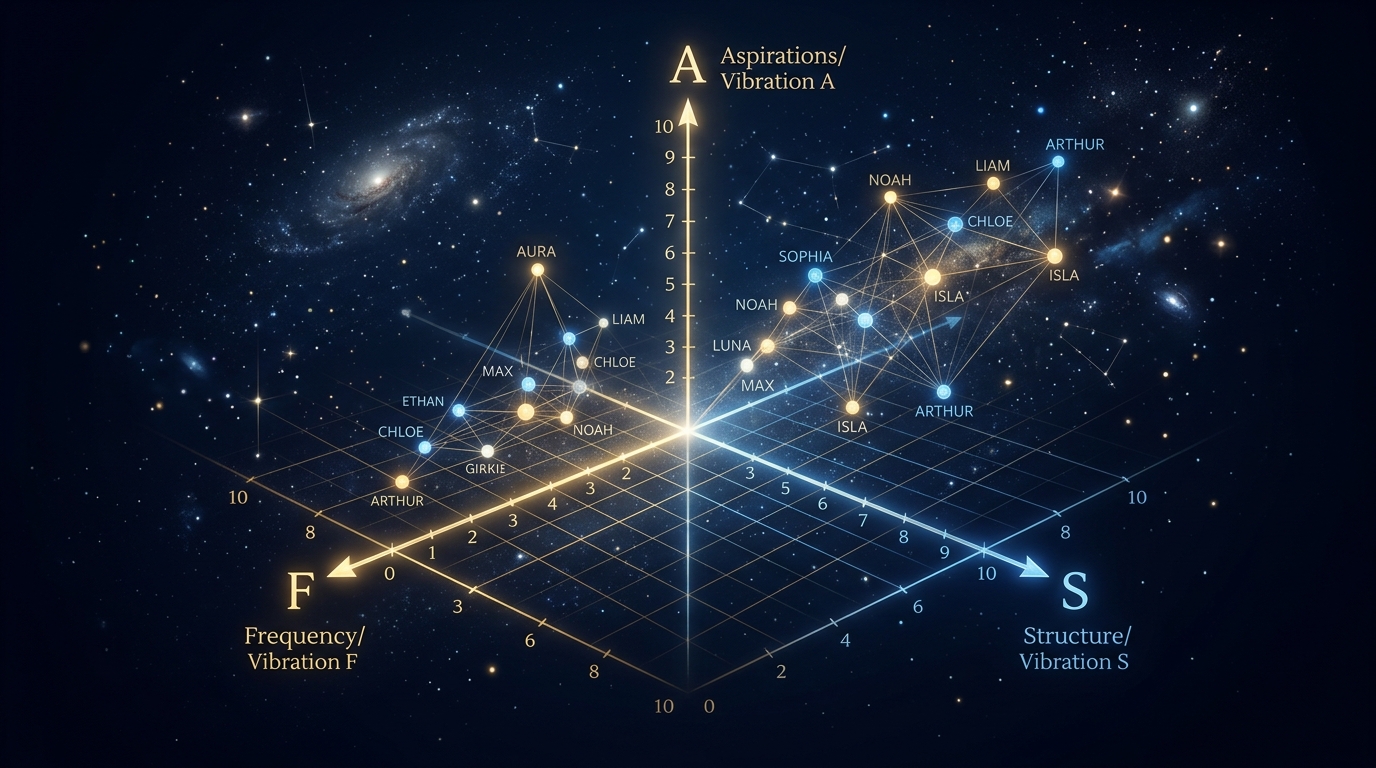
This is why Akasha Numerology (see the complete breakdown in Cosmic Echoes: The What, Why, and How of Akasha Numerology) reads your name across three independent dimensions: Amplitude, Frequency, and Stability — the AFS profile. Not a number. A coordinate. A position in acoustic space that captures what a single digit can’t.
Why Three Dimensions?
Think about how sound actually works.
Every sound wave has three properties you can measure: how loud it is (amplitude), how high-pitched it is (frequency), and how long it sustains (duration). These aren’t metaphors — they’re real, physical quantities.
Your name, when spoken aloud, is a sequence of these sound waves. Each letter makes a distinct sound with its own profile across all three properties. AkaNum captures this by scoring each letter (1-9) on three separate scales:
| Dimension | Symbol | Question It Answers | Physical Root |
|---|---|---|---|
| Amplitude | A | How open and expansive is the sound? | Vocal aperture & Sound Intensity Level SIL dB (Fletcher 1953) |
| Frequency | F | How high and dynamic is the pitch? | Spectral Centroid Hz & Formant F2 (Peterson & Barney 1952) |
| Stability | S | How sustained and grounded is the sound? | Segmental duration ms (Klatt 1976) & Harmonics-to-Noise Ratio |
The result: every letter in your name becomes a point in 3D space, not a dot on a line. Your full name becomes a cloud of these points — and the center of that cloud is your AFS coordinate.
Amplitude: The Openness of Your Sound
Amplitude (A) measures how open your name sounds — how much space it fills when spoken aloud.
Try it yourself. Say “ahhh” — feel how wide your mouth opens? Now say “k” — your tongue blocks the air completely. Open vowels are loud and resonant; hard consonants are tight and clipped. Linguists have measured this spectrum for over a century. AkaNum uses it to read the openness of your name.
What does your Amplitude reveal?
High Amplitude names are dominated by open, resonant sounds. They fill a room the way a cello fills a concert hall — warm, present, and impossible to ignore.
- Qualities associated with high A: emotional expressiveness, social warmth, openness to experience, generous presence
- Think of names rich in open vowels: Alana, Omar, Arianna
Low Amplitude names are built from tighter, more focused sounds. They cut through noise like a laser — precise, directed, economical.
- Qualities associated with low A: strategic reserve, focused intensity, precision in communication, quiet authority
- Think of names dense with consonants: Scott, Bridget, Fritz
Neither is better. A cello isn’t superior to a laser. They serve different purposes — and both can be extraordinary.
Frequency: Pitch and Rhythm
Frequency (F) operates on two complementary levels:
- Phoneme Pitch (Micro): The physical spectral centroid of each individual sound — ranging from deep, low-frequency nasals like M (~200Hz) to crisp, high-frequency sibilants like S (~6000Hz).
- Spectral Rhythm (Macro): How quickly your name shifts between high and low pitch, and open and closed sounds across its syllables.
This one you can feel in your mouth. Say “Patrick” aloud and notice the constant opening and shutting: “P” seals, “a” opens wide, “t” seals again, “r” half-opens, “i” opens, “ck” shuts it down. That’s high frequency — rapid spectral shifts, constant movement.
Now say “Luna.” The “L” glides, the “u” opens smoothly, the “n” gently settles, the “a” opens again. Almost no abrupt changes. That’s low frequency — a smooth, flowing curve.
What does your Frequency reveal?
| High F | Low F |
|---|---|
| Rapid mental shifts | Deliberate processing |
| Adaptability, versatility | Steadiness, patience |
| Thrives in dynamic environments | Thrives in stable environments |
| May struggle with stillness | May struggle with sudden change |
| Energy pattern: staccato | Energy pattern: legato |
Think of Frequency as the tempo of your name’s music. Some names are jazz — improvised, syncopated, surprising. Others are ambient — spacious, gradual, meditative. Neither tempo is right or wrong. But knowing your tempo helps you understand why certain environments energize you and others drain you.
Stability: Your Vibrational Ground
Stability (S) is the most distinctive dimension — the one that has no equivalent in any other numerology system.
Stability measures the consistency of your name’s sound pattern. Does your name stay at a similar energy level throughout, or does it swing between extremes?
Think of two heartbeat monitors. One shows a calm, steady pulse — even and predictable. The other shows wild spikes and dips. Both are healthy — but they describe fundamentally different types of energy.
AkaNum uses three archetypes to make Stability intuitive:
| Archetype | Stability Level | Character |
|---|---|---|
| Crystal | High S (≥7) | Structured, disciplined, resilient. Energy is organized like a crystal lattice — strong, consistent, hard to disrupt. Holds form under pressure. |
| Stream | Mid S (4-6) | Balanced flow, dynamic but not chaotic. Adapts without losing direction — like water finding its path. Versatile energy. |
| Sponge | Low S (≤3) | Absorbent, empathic, highly responsive to environment. Takes in everything — which is both a gift (sensitivity, depth) and a challenge (boundaries, overstimulation). |
Your Stability archetype isn’t destiny — it’s tendency. A Crystal person can be flexible. A Sponge person can be disciplined. But knowing your natural ground state helps you play to your strengths and anticipate your blind spots.
How AFS Works Together
The real magic isn’t any single dimension — it’s how all three combine.
Imagine two people who both get a Destiny Number of 5 in traditional numerology. On paper, they’d look similar — adventurous, freedom-loving, dynamic.
But look at their AFS profiles and a very different picture emerges:
| Person | Destiny | A | F | S | Profile |
|---|---|---|---|---|---|
| Person A | 5 | High | High | Low | Expansive presence + rapid shifts + sponge sensitivity = intense, empathic adventurer who absorbs every experience |
| Person B | 5 | Low | Low | High | Focused precision + steady rhythm + crystal structure = methodical explorer who prefers deep, sustained investigation |
Same Pythagorean number. Completely different acoustic portraits. This is the resolution that three dimensions provide — the difference between seeing a dot on a map and understanding the terrain.
The Catherine/Katherine Test
Here’s a concrete example of why acoustic dimensions matter.
Catherine and Katherine produce different numbers in Pythagorean numerology (C=3, K=2 — different letter positions). But speak both names aloud. They sound exactly the same. Same mouth movements, same rhythm, same impression on the listener.
In AkaNum, they produce the same AFS profile — because AkaNum reads sound, not spelling. The same openness, the same rhythm, the same stability. The same vibrational fingerprint.
This isn’t a flaw in Pythagorean — it’s simply a different design choice. Pythagorean reads the written form. AkaNum reads the spoken form. Both perspectives offer value. But if you believe that vibration is fundamental to reality, then measuring the actual vibration directly adds a layer that letter-based systems can’t.
What Your AFS Profile Doesn’t Do
Transparency matters. Here’s what AFS is — and isn’t:
- ✅ A lens for self-reflection — patterns worth exploring, not verdicts to live by
- ✅ Grounded in real phonetics — the acoustic measurements are scientifically standard
- ✅ A complement to traditional numerology — see your Pythagorean and Akasha readings side by side
- ❌ Not a personality test — it reveals acoustic patterns, not clinical assessments
- ❌ Not predictive — AFS describes tendencies in your name’s vibration, not your future
- ❌ Not a replacement for the depth of traditional number interpretation
We show both systems because both illuminate something real. The places where they agree build confidence. The places where they disagree reveal hidden complexity worth exploring.
See Your Three Dimensions
Ready to discover where your name sits in 3D acoustic space?
- Open the AkaNum calculator
- Enter your full birth name and date of birth
- Find the Akasha panel (gold cards) — your A, F, and S values are displayed for Destiny, Soul, and Persona
- Notice your polarization archetype (Crystal, Stream, or Sponge)
- Compare with your Pythagorean numbers — where do the two lenses agree? Where do they diverge?
The most revealing readings are often the surprises — the dimension you didn’t expect, the archetype that makes you pause and think, “Actually… that does sound like me.”
A single number tells you what energy you carry. Three dimensions tell you how that energy moves, where it grounds, and why it resonates the way it does.
References & Further Reading
- AkaNum Fundamentals: Explore the core principles in Cosmic Echoes: The What, Why, and How of Akasha Numerology.
- The Science of Names: Deep dive into how spelling translates to resonance in The Physics Behind Your Name.
- System Comparison: Read the detailed differences in Pythagorean vs. Chaldean vs. Akasha Numerology.
Ready to see your numbers?
Calculate your Life Path, Destiny, Soul, and Persona numbers — with both Pythagorean and Akasha analysis.
Try the Free Calculator →