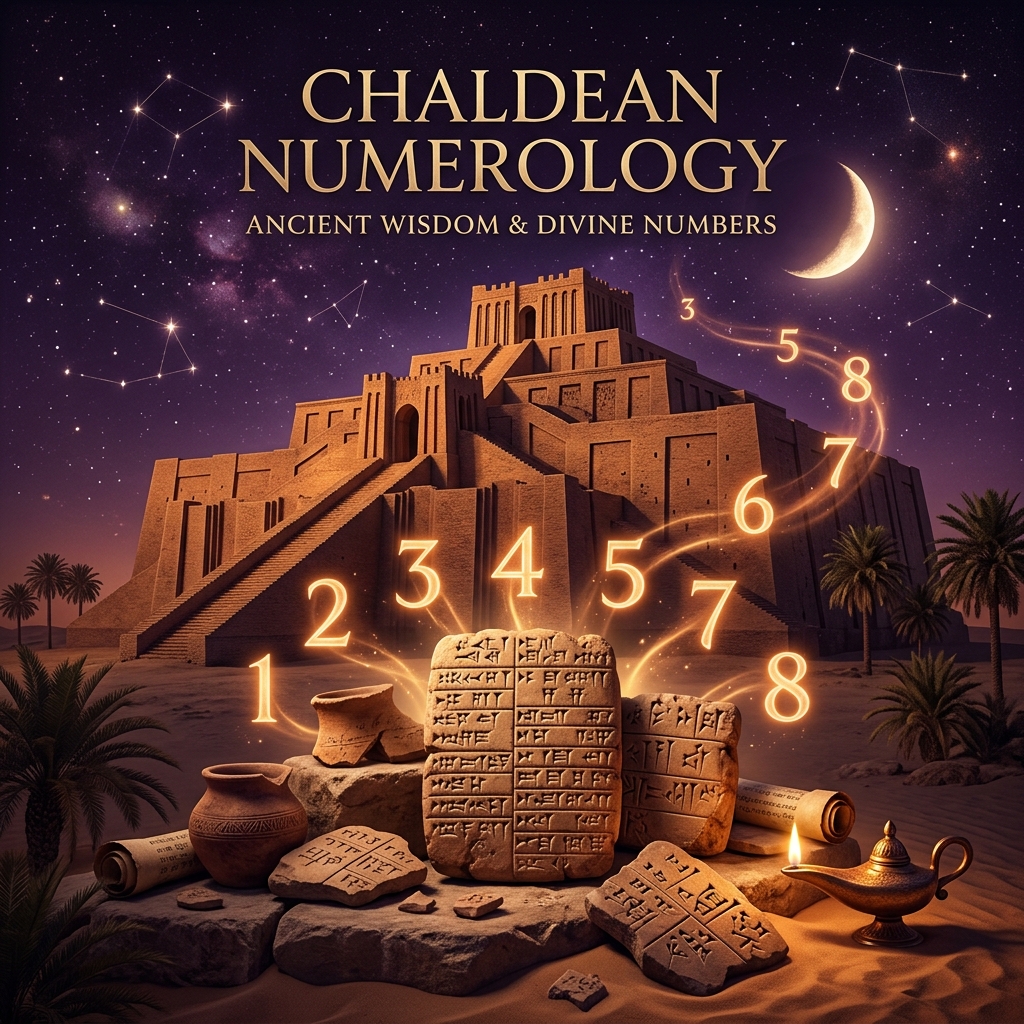
Chaldean Numerology: The Ancient Babylonian System Explained
What Is Chaldean Numerology?
Chaldean numerology is one of the oldest known number systems, originating from ancient Babylonia (modern-day Iraq) around 4,000 years ago. Unlike the more popular Pythagorean system, Chaldean numerology assigns letters to numbers based on vibrational resonance rather than alphabetical order — and it treats compound (double-digit) numbers as meaningful in their own right.
Many experienced practitioners consider it the more “accurate” or “mystical” of the two Western systems, though it’s significantly harder to learn.
A Brief History
The Chaldeans were a Semitic people who ruled Babylonia from the late 7th to mid-6th century BCE. Their culture was deeply rooted in astronomy, mathematics, and divination:
- They built the ziggurats — stepped temples used for celestial observation
- They developed one of the earliest base-60 number systems (which is why we still have 60 seconds in a minute)
- They believed that numbers carried mystical vibrations that connected the earthly and divine realms
The numerology system attributed to them was likely developed over centuries by Babylonian priests who observed correlations between sounds, numbers, and natural phenomena.
How It Works: The Letter-Number Map
The Chaldean mapping is not sequential. Letters are assigned to numbers 1-8 (not 1-9) based on their perceived vibrational quality:
| 1 | 2 | 3 | 4 | 5 | 6 | 7 | 8 |
|---|---|---|---|---|---|---|---|
| A | B | G | D | E | U | O | F |
| I | K | L | M | H | V | Z | P |
| J | R | S | T | N | W | ||
| Q | X | ||||||
| Y |
Key Differences from Pythagorean:
- No number 9 — The Chaldeans considered 9 sacred and divine, so no letter maps to it. You can only get 9 through reduction.
- Non-sequential — S=3 (not 1), H=5 (not 8), etc. The mapping is based on vibrational similarity, not alphabet position.
- Uses common name, not birth name — Chaldean numerology analyzes the name you’re known by today, not necessarily your birth certificate name.
Compound Numbers: The Hidden Layer
One of Chaldean numerology’s most distinctive features is its emphasis on compound numbers (double-digit numbers before reduction).
In Pythagorean, 14 simply reduces to 5. But in Chaldean, 14 is “The Media Number” — it carries its own meaning in addition to the reduced value of 5.
Example Compound Numbers:
| Compound | Name | Meaning |
|---|---|---|
| 10 | Wheel of Fortune | Cycles of rise and fall |
| 11 | The Lion | Hidden dangers behind a powerful exterior |
| 13 | The Transformer | Change and upheaval (not “unlucky”) |
| 14 | The Media Number | Communication and movement |
| 19 | The Sun | Success after struggle |
| 23 | The Royal Star | Promise of success through talent |
There are traditional interpretations for numbers up to 52, making Chaldean readings considerably more layered than their Pythagorean counterparts.
Core Calculation Example: “JOHN”
| Letter | J | O | H | N |
|---|---|---|---|---|
| Chaldean Value | 1 | 7 | 5 | 5 |
Sum: 1 + 7 + 5 + 5 = 18 (compound: “The Moon” — intuition, hidden enemies, spiritual growth)
Reduced: 1 + 8 = 9
Compare this to Pythagorean where JOHN = 2. The same name produces completely different numbers in each system.
Strengths of the Chaldean System
- ✅ Vibrational mapping — letters grouped by perceived resonance, not alphabet order
- ✅ Compound numbers — adds a layer of depth absent in Pythagorean
- ✅ Uses current name — reflects who you are now, not just who you were at birth
- ✅ Ancient pedigree — arguably older than the Pythagorean tradition
- ✅ Considered more accurate by many professional numerologists
Limitations
- ⚠️ Difficult to learn — the non-sequential mapping must be memorized
- ⚠️ Fewer resources — much less documentation than Pythagorean
- ⚠️ The “vibrational” mapping is undocumented — we don’t have original Chaldean texts explaining why each letter maps to its number
- ⚠️ Still letter-based — like Pythagorean, it maps letters to numbers, not sounds to numbers
- ⚠️ Inconsistent across sources — different practitioners sometimes use different mappings
The question both Pythagorean and Chaldean leave open: if numbers represent vibrations, shouldn’t we measure the actual vibration — the sound — rather than the written letter? This is the starting point of Akasha Numerology.
Chaldean vs Pythagorean: Quick Comparison
| Aspect | Pythagorean | Chaldean |
|---|---|---|
| Origin | Ancient Greece (~500 BCE) | Ancient Babylonia (~2000 BCE) |
| Mapping | Sequential (A=1, B=2…) | Vibrational (non-sequential) |
| Range | 1-9 | 1-8 (9 is sacred) |
| Name used | Full birth name | Common/known name |
| Compound numbers | Not emphasized | Central feature |
| Ease of use | ⭐⭐⭐⭐⭐ | ⭐⭐ |
| Depth | ⭐⭐⭐ | ⭐⭐⭐⭐ |
For a deeper three-way comparison including Akasha, see our full comparison article.
Chaldean Numerology and AkaNum
AkaNum’s calculator currently focuses on Pythagorean and Akasha analysis. We don’t include Chaldean calculations — not because the system lacks value, but because our mission is to explore the frontier of acoustic numerology, which addresses the same question the Chaldeans asked (“what vibration does this letter carry?”) with a different methodology: measuring the actual phonetic properties of how names sound.
In a sense, Akasha Numerology is the Chaldean question answered with modern tools.
Keep Reading
- What is Pythagorean Numerology? — The Western standard
- What is Akasha Numerology? — The acoustic science approach
- Pythagorean vs Chaldean vs Akasha — Side-by-side comparison
- Try the Calculator → — See your Pythagorean + Akasha numbers
Ready to see your numbers?
Calculate your Life Path, Destiny, Soul, and Persona numbers — with both Pythagorean and Akasha analysis.
Try the Free Calculator →